
Career Change to Cloud Computing in 2026
If you are reading this from a cubicle in a completely different industry, wondering whether cloud computing is a realistic career change, the answer is yes. Cloud is one of the most accessible technology fields for people without a traditional computer science background, and this guide will show you exactly why and how.
I have worked with dozens of career changers who successfully transitioned into cloud roles. Teachers, nurses, accountants, military veterans, restaurant managers, and retail supervisors. They all followed a similar path, and the pattern is repeatable. This guide is that pattern, written down.
What You Will Learn
By the end of this article, you will be able to:
- Identify which of the six major cloud role types best matches your existing skills and career background
- Describe a realistic learning path from zero cloud experience to interview-ready, including certification sequence and timeline
- Explain how to reframe non-technical work experience as transferable cloud skills on a resume and in interviews
- Differentiate between the three types of portfolio projects that hiring managers expect to see
- Evaluate realistic salary ranges and timelines based on your starting point
Why Cloud Computing Is Ideal for Career Changers
Let me start with the numbers, because numbers matter when you are considering leaving a stable job.
The Job Market Data
The cloud computing industry has been growing at 20-25% annually for the past five years. Here are the numbers that matter:
| Metric | Value | Source |
|---|---|---|
| Global cloud market size (2025) | $680+ billion | Gartner |
| Projected size (2028) | $1.2+ trillion | Gartner |
| Unfilled cloud jobs (US, 2025) | 300,000+ | Burning Glass/LinkedIn |
| Average time to fill a cloud role | 45+ days | LinkedIn Talent Insights |
| YoY growth in cloud job postings | 22% | Indeed Hiring Lab |
| % of companies using cloud | 94% | Flexera State of Cloud |
That last statistic is the most important one. When 94% of companies use cloud services, cloud skills are not optional for businesses. They are infrastructure. And infrastructure needs people to build and maintain it.
Why You Do Not Need a CS Degree
Cloud computing is fundamentally about understanding systems, solving problems, and following documentation. You do not need to write complex algorithms or understand compiler theory. Most cloud work involves:
- Configuring services through a console or CLI (clicking buttons and running commands)
- Connecting services together (making Service A talk to Service B)
- Making decisions about architecture trade-offs (cost vs performance vs availability)
- Reading and following documentation (AWS has the best docs in tech)
- Troubleshooting when things go wrong (detective work, not rocket science)
AWS alone offers over 200 services. Nobody knows all of them. Even senior architects with 15 years of experience specialize in a subset. This means you are not competing against people with decades of head start. You are learning a platform that is constantly releasing new services that everyone has to learn from scratch.
When AWS launched a new service last month, the 20-year veteran and the career changer both started at zero. That is a uniquely level playing field.
Skills You Already Have That Transfer
You might be surprised how many of your current skills are directly relevant. Cloud is not purely technical. The best cloud professionals combine technical knowledge with business acumen, communication skills, and domain expertise.
Direct Skill Transfers
| Your Current Background | Cloud-Relevant Skills | Best-Fit Cloud Roles |
|---|---|---|
| Project Management | Deployment planning, stakeholder communication, risk assessment | Cloud Consultant, TAM, DevOps PM |
| Financial Analysis | Cost optimization, budgeting, ROI modeling | FinOps Engineer, Cloud Economist |
| Customer Service | Client communication, problem resolution, documentation | Cloud Support Engineer, TAM |
| Healthcare/Compliance | Security governance, audit readiness, regulatory knowledge | Cloud Security Engineer, GRC |
| Teaching/Training | Technical writing, concept explanation, curriculum design | Solutions Architect, Developer Advocate |
| Military | Operations, incident response, leadership under pressure | SRE, Platform Engineer, DevOps |
| Retail Management | Resource optimization, scheduling, process improvement | Cloud Operations, Cost Optimization |
| Accounting | Attention to detail, process documentation, auditing | Cloud Governance, Compliance |
| Sales | Stakeholder management, ROI communication, needs assessment | Cloud Sales Engineer, Solutions Architect |
| Legal | Contract analysis, compliance, risk management | Cloud Security, Vendor Management |
The "Secret" Skills That Matter Most
After working with hundreds of cloud professionals, I can tell you the skills that separate good engineers from great ones are not technical:
- Written communication. Cloud work is remote-heavy. You will write more documentation, emails, and Slack messages than code.
- Problem decomposition. Breaking a big problem into smaller, solvable pieces. This is a life skill, not a tech skill.
- Learning agility. The ability to learn new things quickly by reading documentation. If you taught yourself anything (a language, an instrument, a hobby), you have this.
- Business context. Understanding WHY a company needs a particular architecture, not just HOW to build it. Career changers often have better business instinct than pure technologists.
The 6 Major Cloud Role Types
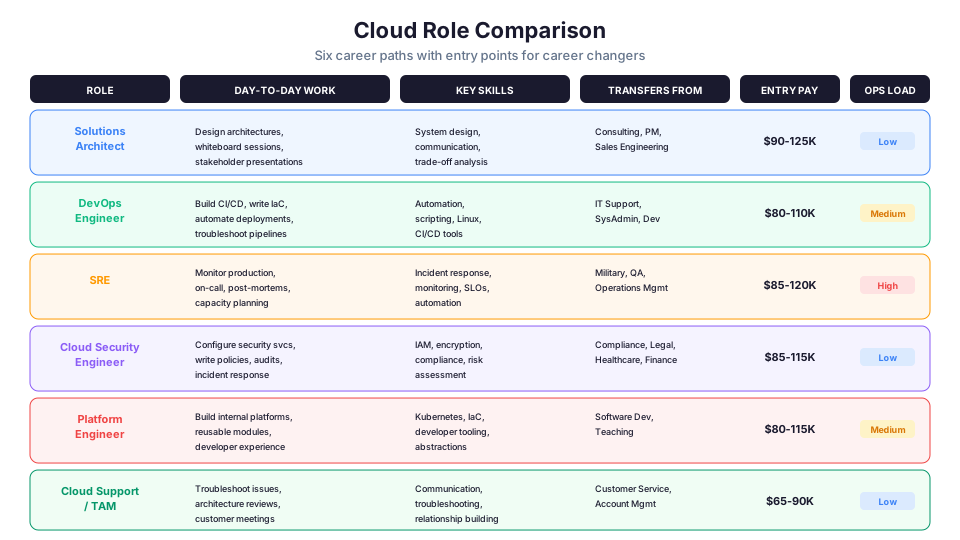
Not all cloud jobs are the same. Here is what each role actually looks like day to day.
1. Cloud Solutions Architect
What you do: Design cloud architectures that meet business requirements. You translate "we need a system that handles 10,000 users with 99.9% uptime" into specific AWS services, configurations, and diagrams.
Day-to-day: Whiteboard sessions, architecture reviews, writing design documents, presenting to stakeholders, staying current with new services.
Best for career changers from: Consulting, project management, sales engineering, systems analysis.
2. Cloud/DevOps Engineer
What you do: Build and maintain the infrastructure that runs applications. You write Infrastructure as Code, set up CI/CD pipelines, automate deployments, and ensure systems are reliable.
Day-to-day: Writing Terraform/CloudFormation, troubleshooting deployments, building automation scripts, monitoring system health, responding to alerts.
Best for career changers from: IT support, system administration, software development, manufacturing (process automation).
3. Site Reliability Engineer (SRE)
What you do: Ensure production systems are reliable, fast, and scalable. You write automation to prevent incidents, respond to outages, and use data to improve system performance.
Day-to-day: Monitoring dashboards, writing runbooks, conducting post-mortems, building alerting systems, on-call rotation, capacity planning.
Best for career changers from: Operations management, quality assurance, military operations, emergency services.
4. Cloud Security Engineer
What you do: Protect cloud environments from threats. You configure security services, write policies, conduct audits, respond to security incidents, and ensure compliance with regulations.
Day-to-day: Reviewing access policies, configuring WAF rules, analyzing GuardDuty findings, writing security documentation, conducting assessments.
Best for career changers from: Compliance, legal, risk management, healthcare (HIPAA), financial services (SOX/PCI).
5. Platform Engineer
What you do: Build internal developer platforms that make it easy for other engineers to deploy and manage applications. You create self-service tools, templates, and abstractions.
Day-to-day: Building reusable infrastructure modules, creating developer documentation, managing Kubernetes clusters, optimizing deployment workflows.
Best for career changers from: Software development, teaching (creating learning paths), technical writing, process engineering.
6. Cloud Support Engineer / Technical Account Manager
What you do: Help customers solve cloud problems. You troubleshoot issues, provide architectural guidance, and build relationships with enterprise clients.
Day-to-day: Answering support cases, conducting architecture reviews, writing best-practice documentation, presenting at customer meetings.
Best for career changers from: Customer service, consulting, account management, technical support.
Salary Ranges by Role and Experience
These numbers reflect the United States market in 2025. Adjust down 10-20% for fully remote positions at companies not in major tech hubs. Adjust up 10-30% for high-cost-of-living areas (SF, NYC, Seattle).
| Role | Entry Level (0-2 yr) | Mid Level (2-5 yr) | Senior (5+ yr) | Principal/Staff |
|---|---|---|---|---|
| Cloud Support Engineer | $65K - $90K | $90K - $120K | $120K - $150K | $150K+ |
| Cloud/DevOps Engineer | $80K - $110K | $110K - $150K | $150K - $190K | $190K - $250K |
| Solutions Architect | $90K - $125K | $125K - $170K | $170K - $220K | $220K - $300K |
| SRE | $85K - $120K | $120K - $165K | $165K - $210K | $210K - $280K |
| Cloud Security Engineer | $85K - $115K | $115K - $155K | $155K - $200K | $200K - $260K |
| Platform Engineer | $80K - $115K | $115K - $155K | $155K - $200K | $200K - $260K |
| FinOps Engineer | $75K - $100K | $100K - $140K | $140K - $180K | $180K - $220K |
| Technical Account Manager | $80K - $110K | $110K - $145K | $145K - $180K | $180K - $220K |
Important notes about compensation:
- These ranges include base salary only. Total compensation (base + bonus + equity) can be 20-50% higher at large tech companies.
- Remote positions at smaller companies tend toward the lower end.
- Certifications typically add $5K-$15K to offers at the same experience level.
- Government/public sector roles pay 10-20% less but often have better benefits and stability.
The Complete Learning Path
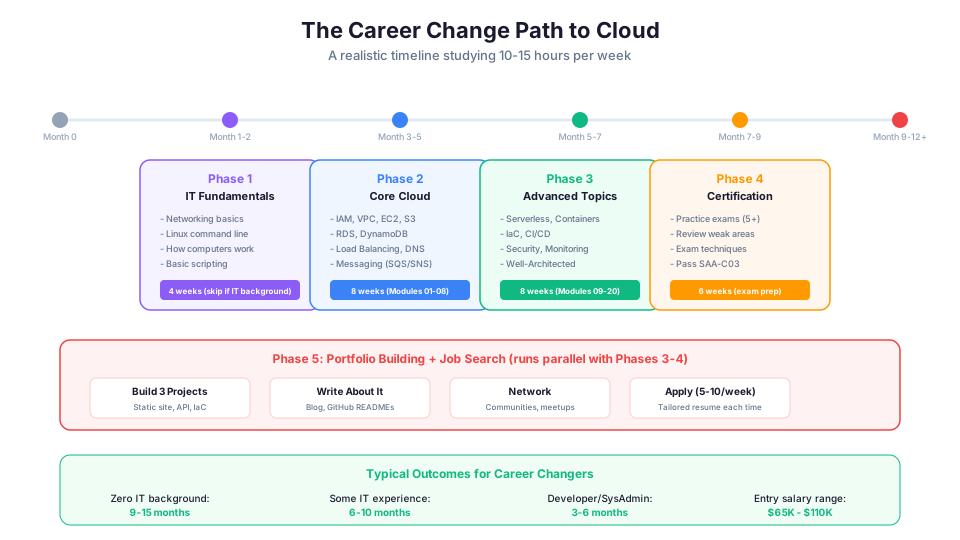
Here is the exact path I recommend for career changers studying 10-15 hours per week. This is not a theoretical framework. This is what has worked for the people I have mentored.
Phase 1: IT Fundamentals (Weeks 1-4)
Skip this phase if you already work in IT or have strong computer literacy. Otherwise, you need a foundation.
What to learn:
- How computers work (CPU, RAM, storage, networking)
- Operating system basics (file systems, processes, permissions)
- Networking fundamentals (IP addresses, DNS, HTTP, ports, TCP/UDP)
- Command line basics (navigating directories, running commands, reading output)
- Basic scripting concepts (variables, loops, conditionals)
Resources:
- CompTIA IT Fundamentals (ITF+) study materials
- Our IT Fundamentals track
- Linux command line tutorials (free on YouTube)
Milestone: You can SSH into a remote server, navigate the file system, and explain what an IP address is.
Phase 2: Core Cloud Concepts (Weeks 5-12)
This is where the cloud learning begins. You will cover the foundational services that appear in every cloud architecture.
What to learn:
- Cloud computing concepts (IaaS, PaaS, SaaS, shared responsibility)
- AWS accounts, IAM users, groups, roles, and policies
- Networking: VPCs, subnets, routing, security groups, NACLs
- Compute: EC2 instances, AMIs, Auto Scaling, instance types
- Storage: S3 buckets, storage classes, lifecycle policies
- Databases: RDS, DynamoDB, choosing between SQL and NoSQL
- Load balancing: ALB, NLB, target groups, health checks
- DNS: Route 53, routing policies
- Messaging: SQS, SNS, EventBridge
Resources:
- Bootcamp Modules 01-08
- AWS Free Tier hands-on labs
- AWS Skill Builder digital training (supplement, free and subscription tiers)
Milestone: You can draw a three-tier architecture (web, app, database) on a whiteboard and explain each component's role.
Phase 3: Advanced Topics (Weeks 13-20)
Now you build depth in the areas that separate certified professionals from casual learners.
What to learn:
- Serverless: Lambda functions, API Gateway, Step Functions
- Containers: Docker basics, ECS, Fargate
- Infrastructure as Code: CloudFormation or CDK
- CI/CD: CodePipeline, CodeBuild, deployment strategies
- Security: KMS, Secrets Manager, WAF, Shield, GuardDuty
- Monitoring: CloudWatch metrics, alarms, logs, X-Ray
- Cost optimization: Reserved Instances, Savings Plans, Cost Explorer
- Reliability: Multi-AZ, multi-region, disaster recovery patterns
- Well-Architected Framework: all six pillars
Resources:
- Bootcamp Modules 09-20
- AWS Well-Architected Labs (free)
- Practice building real projects
Milestone: You can design a fault-tolerant, cost-optimized architecture and explain your design decisions.
Phase 4: Certification Prep (Weeks 21-26)
With the knowledge from Phases 2-3, certification prep is mostly about exam technique, not learning new content.
What to do:
- Take practice exams (minimum 5 full-length tests)
- Review every wrong answer and understand WHY it was wrong
- Focus on weak areas identified by practice tests
- Learn the exam-specific patterns (how AWS wants you to answer)
- Get comfortable with the 65-question, 130-minute format
Milestone: You consistently score 80%+ on practice exams across multiple providers.
Phase 5: Portfolio and Job Search (Weeks 27-36)
This runs in parallel with certification prep and continues after.
What to do:
- Build 3 portfolio projects (see below)
- Write about what you built (blog posts or GitHub READMEs)
- Update your resume with cloud skills and projects
- Start networking (communities, meetups, LinkedIn)
- Apply to roles (aim for 5-10 applications per week)
- Practice interview questions (behavioral AND technical)
Milestone: You land your first cloud role.
The Certification Roadmap
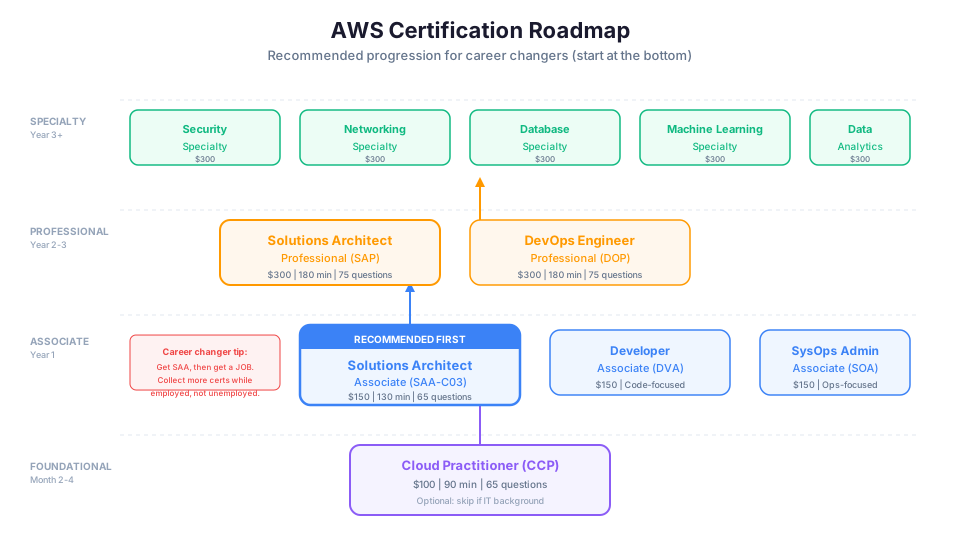
Certifications matter for career changers. They signal to hiring managers that you have verified knowledge when you do not have years of professional experience to point to.
Which Certification First?
There are two schools of thought:
Path A: Start with Cloud Practitioner (CCP)
- Best for: People with zero IT background, those who want confidence early
- Timeline: 2-4 weeks of study after completing Phase 2
- Value: Low technical bar, good confidence builder, checks the "AWS certified" box
- Cost: $100 exam fee
Path B: Skip straight to Solutions Architect Associate (SAA)
- Best for: People with some IT background, those who want maximum ROI on study time
- Timeline: 6-12 weeks of study after completing Phase 3
- Value: The single most recognized cloud certification in the industry
- Cost: $150 exam fee
My recommendation: If you are a complete beginner to technology, start with CCP. It gives you a quick win and familiarizes you with the exam format. If you have any IT background at all (even self-taught), skip CCP and go straight to SAA. The content overlap is significant, and SAA carries much more weight with hiring managers.
The Full Certification Progression
| Order | Certification | Level | Study Time | When to Take |
|---|---|---|---|---|
| 1 | Cloud Practitioner (CCP) | Foundational | 2-4 weeks | Optional: after Phase 2 |
| 2 | Solutions Architect Associate (SAA) | Associate | 6-12 weeks | After Phase 3-4 |
| 3 | Developer Associate (DVA) or SysOps Associate (SOA) | Associate | 4-8 weeks | After first cloud job |
| 4 | Solutions Architect Professional (SAP) | Professional | 8-16 weeks | After 2+ years experience |
| 5 | Specialty (Security, Networking, etc.) | Specialty | 4-8 weeks | Based on career focus |
Certification Tips for Career Changers
- One cert is enough to get hired. Do not collect certifications while unemployed. Get SAA, then focus on getting a job. Additional certs are better pursued while employed.
- The exam is not a memory test. Understanding WHY AWS recommends something is more important than memorizing specific numbers.
- Practice exams are essential. Use AWS Skill Builder's Official Practice Exam (included in the subscription) and the free Official Practice Question Set on AWS Certification to see realistic question styles and difficulty.
- The free retake voucher. AWS occasionally offers free retake vouchers. Check if one is available before booking your exam.
- Pearson VUE vs PSI. Both testing providers work fine. If one has closer testing centers or more available dates in your area, use that one. Online proctored exams work too but require a very clean desk and room.
Building a Portfolio That Gets Interviews
Certifications open doors. Portfolios close deals. When a hiring manager is deciding between two candidates with the same certification, the one with a portfolio wins every time.
The 3 Project Types You Need
Project 1: The Static Website Pipeline (shows CI/CD + serverless)
Build a personal website or blog deployed using:
- S3 for static hosting
- CloudFront for CDN
- Route 53 for DNS
- CodePipeline or GitHub Actions for automated deployment
- Infrastructure defined in CloudFormation or CDK
Why it works: Shows end-to-end thinking. You did not just build something; you automated its deployment and made it production-quality.
Project 2: The Serverless API (shows event-driven architecture)
Build a REST API that does something useful:
- API Gateway for HTTP endpoints
- Lambda functions for business logic
- DynamoDB for data storage
- Cognito for authentication (bonus points)
- CloudWatch for monitoring
Example ideas:
- URL shortener (like bit.ly)
- Task management API
- Weather data aggregator
- Personal finance tracker
Why it works: Demonstrates understanding of modern cloud architecture patterns. Most new workloads are serverless or container-based, not EC2-based.
Project 3: The Infrastructure Automation (shows IaC + DevOps)
Build a multi-tier application deployed entirely through Infrastructure as Code:
- VPC with public and private subnets
- Auto Scaling group behind an ALB
- RDS database in private subnet
- All defined in CloudFormation or Terraform
- Include a CI/CD pipeline that updates infrastructure
Why it works: Shows you can manage infrastructure at scale. This is what you will actually do in a cloud engineering role.
Portfolio Presentation Tips
- Put everything on GitHub with clear README files explaining architecture decisions
- Include architecture diagrams (even simple ones from draw.io)
- Document trade-offs ("I chose DynamoDB over RDS because...")
- Include cost estimates showing you understand the financial implications
- Show it working with screenshots or a live demo URL
Resume Tips for Career Changers
Your resume needs to tell a story: "I have transferable skills AND I have built real things with cloud technology."
The Format That Works
[Your Name]
Cloud Engineer | AWS Solutions Architect Associate
[City, State] | [Email] | [LinkedIn] | [GitHub]

PROFESSIONAL SUMMARY
Career changer with [X years] in [previous field] transitioning to
cloud engineering. AWS Solutions Architect Associate certified with
hands-on experience building serverless applications, automating
infrastructure, and optimizing cloud costs. Combines technical cloud
skills with [key transferable skill] from [previous field].

CERTIFICATIONS
- AWS Solutions Architect Associate (SAA-C03) | [Month Year]

CLOUD PROJECTS
[Project Name] | GitHub: [link] | Live: [link]
- Built [what] using [which AWS services]
- Implemented [specific feature] resulting in [measurable outcome]
- Automated deployment using [tool], reducing deployment time from X to Y

TECHNICAL SKILLS
Cloud: AWS (EC2, Lambda, S3, RDS, DynamoDB, VPC, IAM, CloudFormation)
Tools: Terraform, Docker, Git, Linux, Python/Bash
Methodologies: CI/CD, Infrastructure as Code, Well-Architected Framework

PROFESSIONAL EXPERIENCE
[Previous Job Title] | [Company] | [Dates]
- [Reframe accomplishments in terms of cloud-relevant skills]
- [Focus on: problem-solving, systems thinking, automation, cost management]
How to Reframe Non-Tech Experience
| Previous Accomplishment | Cloud-Relevant Framing |
|---|---|
| "Managed team of 12 people" | "Coordinated cross-functional delivery, similar to managing multi-team cloud migrations" |
| "Reduced department expenses by 15%" | "Identified inefficiencies and optimized resource usage, directly applicable to cloud cost optimization" |
| "Created training materials for new hires" | "Developed technical documentation and onboarding processes, essential for cloud infrastructure documentation" |
| "Handled 50+ customer calls daily" | "Resolved technical issues under time pressure, directly applicable to cloud support and incident response" |
| "Ensured regulatory compliance" | "Implemented governance controls and audit processes, core to cloud security and compliance" |
Resume Mistakes to Avoid
- Do not hide your previous career. Embrace it. "Former teacher turned cloud engineer" is interesting. "Cloud engineer" with a suspicious employment gap is not.
- Do not list 20 AWS services you have barely touched. List the ones you have actually built things with.
- Do not say "self-taught." Say "independently built" or "self-directed learning." These sound more professional.
- Do not apply only to senior roles. "Cloud Engineer" and "Junior Cloud Engineer" are where career changers land. Not "Senior Solutions Architect."
- Do not skip the cover letter. For career changers, the cover letter is where you explain your story. Many hiring managers will not interview a career changer without one.
Networking Strategies That Actually Work
Networking feels uncomfortable for most people. But in tech, your network directly correlates with your access to opportunities. Here are strategies that work without being sleazy.
Online Communities
| Community | Platform | Why It Works |
|---|---|---|
| r/AWSCertifications | Active community answering cert questions daily | |
| AWS Community Builders | AWS Program | Official recognition, access to AWS teams |
| The AWS Trainer Community | Study group for bootcamp students and career changers | |
| TechTwitter/CloudTwitter | X/Twitter | Follow AWS Heroes, engage with their content |
| LinkedIn AWS Groups | Connect directly with hiring managers | |
| Local AWS User Groups | Meetup.com | In-person connections in your city |
The "Give First" Networking Strategy
Instead of asking people for things, give first:
- Answer questions in forums where beginners are stuck. You know more than someone one step behind you.
- Share your learning publicly. "Today I learned how VPC peering works" with a diagram gets engagement.
- Write about your projects and tag relevant people. If you built something using a tutorial, thank the author and show your result.
- Attend meetups and actually participate. Ask questions. Introduce yourself to the speaker afterward.
- Comment thoughtfully on LinkedIn posts by cloud professionals. Not "Great post!" but actual insights.
The Informational Interview Approach
Reach out to cloud professionals (especially career changers) and ask for 15-minute conversations:
Subject: Quick question from an aspiring cloud engineer

Hi [Name],

I saw your post about [specific thing they shared]. I am currently
transitioning from [your field] into cloud engineering and am
[X months] into my learning journey.

Would you have 15 minutes for a quick call? I would love to hear
about your experience transitioning into cloud and any advice for
someone at my stage.

No pressure if you are busy. I appreciate your content either way.

[Your name]
Success rate: About 1 in 5 people will respond positively. Send 20 of these over a month, and you will have 4 conversations with people who can give you real advice, referrals, or mentorship.
Timeline: Realistic Expectations
Let me be honest with you. The "get a cloud job in 3 months" stories you see online are either misleading or exceptional cases with context they are not sharing (like 10 years of prior IT experience).
Realistic Timelines by Background
| Your Starting Point | Time to First Cloud Job | Notes |
|---|---|---|
| Zero IT experience | 9-15 months | Need IT fundamentals first |
| Some IT experience (help desk, etc.) | 6-10 months | Can skip Phase 1 |
| Software developer switching to cloud | 3-6 months | Already have coding + systems knowledge |
| System administrator | 3-5 months | Already understand infrastructure |
| IT manager/consultant | 4-8 months | Strong fundamentals, need hands-on practice |
What "10-15 Hours Per Week" Actually Looks Like
- Weekdays: 1.5 hours per day (before work, lunch break, or after dinner)
- Weekend: 3-4 hours on Saturday OR Sunday (not both; avoid burnout)
- Split: 60% hands-on labs, 30% reading/video, 10% community/networking
The Plateau Is Normal
Around months 3-4, most career changers hit a motivation plateau. You know enough to understand how much you do not know. Imposter syndrome peaks. This is completely normal and is actually a sign of progress. Push through it with:
- Small wins (complete a lab, answer a forum question correctly)
- Accountability partners (study with someone at the same level)
- Visible progress tracking (check off completed modules)
- Remembering your "why" (write it down and review it weekly)
Real Stories of Successful Career Changers
Maria: Teacher to Cloud Support Engineer (11 months)
Maria taught high school math for 8 years. She started studying AWS in January, earned her CCP in April, and SAA in July. She built a serverless quiz application as her portfolio project (combining her teaching background with cloud skills). She was hired as a Cloud Support Engineer at a mid-size company in November. Starting salary: $82,000, compared to her teaching salary of $52,000.
Her advice: "My teaching background was actually my biggest selling point in interviews. I could explain technical concepts clearly, and that is rare."
David: Restaurant Manager to DevOps Engineer (14 months)
David managed a restaurant for 6 years. He started with zero IT knowledge. He spent the first 3 months on IT fundamentals and Linux basics. Then he dove into AWS, earned his SAA after 10 months of study, and built a CI/CD pipeline as his portfolio project. He got hired as a Junior DevOps Engineer at a startup after 14 months total. Starting salary: $88,000.
His advice: "The hardest part was the first 3 months when nothing made sense. Once networking clicked, everything else started connecting."
Sarah: Accountant to Cloud FinOps Engineer (7 months)
Sarah was a CPA for 5 years. Her accounting background gave her a huge advantage in understanding cloud billing, cost allocation, and financial modeling. She earned her SAA and immediately positioned herself for FinOps roles. She was hired in 7 months as a Cloud Financial Analyst. Starting salary: $95,000.
Her advice: "Do not try to become a generic cloud engineer. Find the intersection of your existing expertise and cloud. Mine was finance."
James: Military (Army) to SRE (9 months)
James served 6 years as an Army communications specialist. He already had networking knowledge from military training. He earned his SAA in 4 months and focused on reliability engineering (incident response and operations mapped well to his military experience). Hired as a Junior SRE at a fintech company after 9 months. Starting salary: $105,000.
His advice: "Military discipline is your superpower. You are used to learning complex systems under pressure. Cloud is easier than most military training."
Interview Preparation for Career Changers
Getting an interview is only half the battle. Here is how to prepare for cloud job interviews when you do not have years of experience.
Technical Interview Topics
Most entry-level cloud roles will ask about:
| Topic Area | What They Ask | How to Prepare |
|---|---|---|
| Networking | VPCs, subnets, security groups, DNS | Build a multi-tier VPC from memory |
| IAM | Users, roles, policies, least privilege | Write a policy by hand and explain it |
| Compute | EC2 vs Lambda decision making | Know the trade-offs cold |
| Storage | S3 classes, lifecycle policies, encryption | Explain when to use each class |
| Databases | RDS vs DynamoDB, read replicas, Multi-AZ | Design a database tier for a given scenario |
| High Availability | Multi-AZ, Auto Scaling, load balancing | Draw a fault-tolerant architecture |
| Cost | Reserved vs On-Demand, Savings Plans | Estimate monthly costs for a scenario |
| Security | Encryption at rest/in transit, KMS, WAF | Explain defense in depth |
Behavioral Interview Questions
Career changers get asked "why" questions more than experienced candidates:
-
"Why are you switching to cloud?" Have a clear, positive story. Not "I hated my old job" but "I discovered a passion for systems thinking when I [specific moment]."
-
"How do you know this is not just a phase?" Point to evidence: certifications earned, projects built, time invested (months of study), communities joined.
-
"What will you do when you encounter something you have never seen?" This is a learning agility question. Describe your process: read docs, build a test, ask the community, escalate with specifics.
-
"Tell me about a complex problem you solved." Use your previous career. Frame it in terms of constraints, trade-offs, and outcomes.
-
"Where do you see yourself in 3 years?" Show ambition but be realistic. "I want to become a senior engineer specializing in [area]" is better than "I want to be a VP."
The Whiteboard Challenge
Many cloud interviews include a design question: "Design a system that does X." Here is the framework:
- Clarify requirements (5 minutes): Users, traffic, availability, budget
- Start simple (5 minutes): Draw the basic components (web, app, db)
- Add details (10 minutes): Specific AWS services, how they connect
- Address trade-offs (5 minutes): Cost vs performance vs availability
- Discuss alternatives (5 minutes): "If budget were unlimited..." or "If traffic doubled..."
You do not need to produce a perfect architecture. Interviewers want to see your thought process.
Common Mistakes Career Changers Make
Avoid these pitfalls that I have seen trip up career changers repeatedly:
Mistake 1: Tutorial Hell
Watching 500 hours of video without building anything. Video courses give you familiarity, not competence. For every hour of video, spend two hours building something with your own hands.
Mistake 2: Certification Collecting
Getting 5 certifications before applying to a single job. One certification (SAA) plus a solid portfolio is more valuable than 5 certifications and no practical experience.
Mistake 3: Applying Only to Big Tech
FAANG companies have extremely high bars for entry-level cloud roles. Start with:
- Mid-size companies (500-5000 employees) with cloud teams
- Consulting firms that hire associate-level cloud consultants
- Managed service providers (MSPs) that need cloud engineers
- Government contractors (if you have or can get clearance)
Mistake 4: Underselling Transferable Skills
Do not present yourself as a blank slate. Your previous career gave you real skills. Frame them actively on your resume and in interviews.
Mistake 5: Going It Alone
Career switching is mentally hard. Burnout, imposter syndrome, and rejection are real. Join a cohort or accountability group. The people who succeed almost always have a support system.
Mistake 6: Waiting Until You Feel "Ready"
You will never feel ready. Apply when you have your certification and one portfolio project. You will learn more in your first 3 months on the job than in 3 more months of self-study.
How This Shows Up in Architecture Decisions
When you sit for interviews or work on real architecture reviews, the same patterns come up repeatedly:
Preparation Mindset
- Stop studying new material 3 days before an interview or review. Focus on explaining what you already know.
- Review your weak areas with scenario-based questions only.
- Get proper sleep. Clear thinking beats exhaustive preparation.
During Architecture Discussions
- Time management: In whiteboard sessions, spend the first 5 minutes clarifying requirements before drawing anything.
- Process of elimination: When presented with multiple approaches, explain which you would rule out first and why.
- Read carefully: "Most cost-effective" is different from "highest availability." The scenario tells you what to optimize for.
- Default to AWS best practices: When unsure, pick the approach that aligns with Well-Architected Framework principles.
- Watch for "least operational overhead": This usually means managed or serverless services.
If You Do Not Get the Offer
It is not the end of the world. Ask for feedback, refine your weak areas, and try again. Many successful cloud professionals were rejected multiple times before landing their first role.
Your First Steps Today
Do not let this guide become something you bookmark and never act on. Here are your immediate next steps:
- Create a free AWS account (see our Free Tier guide). This takes 10 minutes.
- Start the appropriate track:
- New to technology: IT Fundamentals
- Some IT background: Module 01: Cloud Fundamentals
- Block study time on your calendar. Treat it like an appointment you cannot cancel. 1.5 hours per day minimum.
- Join one community. Pick one from the table above. Introduce yourself. Ask a question.
- Tell someone your plan. Accountability matters. Tell a friend, partner, or family member that you are making this career change.
Career Change Readiness Self-Assessment
Rate yourself honestly on each item (Ready / In Progress / Not Started):
- I can explain what cloud computing is and why companies use it, in plain English
- I have created an AWS account and logged in to the console at least once
- I can identify which cloud role type best fits my existing skills and interests
- I have blocked at least 10 hours per week on my calendar for study time
- I have joined at least one cloud learning community (WhatsApp, Reddit, local meetup)
- I have told someone in my life about my career change plan (accountability partner)
- I can describe three transferable skills from my current career that apply to cloud work
- I have a target certification in mind and a rough timeline for when I will take it
- I understand the financial implications of the transition (savings runway, study costs)
- I have reviewed at least two cloud job postings to understand what employers expect
Scoring: 8-10 "Ready" items means you are well positioned to start. 5-7 means you have a solid foundation but should fill the gaps before committing full-time. Under 5 means you should focus on the early items before jumping into technical study.
Salary data sourced from LinkedIn, Glassdoor, and Indeed as of early 2026.
Quick Knowledge Check
Test your readiness to start this journey:
- What are the three main categories of cloud roles?
- Why is the Solutions Architect Associate certification recommended as a first cert for most people?
- Name three transferable skills from non-tech careers that apply to cloud work.
- What are the three portfolio projects every career changer should build?
- How long should a career changer realistically expect the transition to take?
- What is the "give first" networking strategy?
- Why does AWS recommend starting with Lambda + DynamoDB for portfolio projects?
- What should you do when you hit the motivation plateau at months 3-4?
- How should you frame non-tech experience on a cloud resume?
- What is an informational interview and why does it work?
Ready to begin your cloud career? The bootcamp starts with Module 01: Cloud Fundamentals and takes you from zero to certification-ready. Every module includes hands-on labs using Free Tier resources. No previous cloud experience required.